Subterranean termite soil treatment protects Richland County structures from below-ground structural invasion. Eastern subterranean termites live in underground colonies and move into crawlspaces and wall voids through…
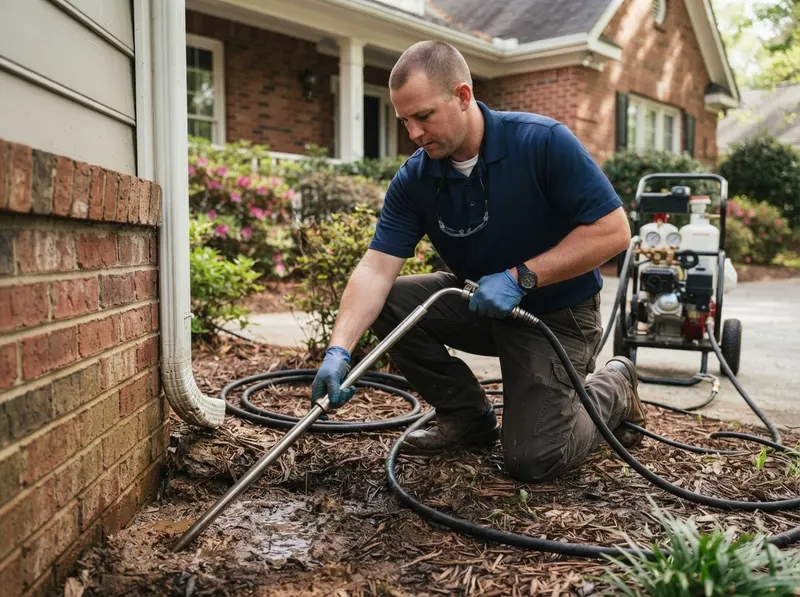
Subterranean termite soil treatment protects Richland County structures from below-ground structural invasion. Eastern subterranean termites live in underground colonies and move into crawlspaces and wall voids through mud shelter tubes. RiverCrest Bug Control uses non-repellent liquid termiticides, such as fipronil, which termites pass through without detection. According to guidance from the Environmental Protection Agency, non-repellent chemicals permit worker termites to transfer the active agent throughout the subterranean colony via grooming behavior, achieving total colony collapse rather than merely repelling insects to untreated structural gaps.
Applying a soil barrier requires digging a 6-inch by 6-inch trench directly against exterior foundation footings, followed by precise chemical application at a standardized rate of 4 gallons per 10 linear feet per foot of depth, compliant with standards published by the Clemson University Department of Pesticide Regulation. Historic crawlspace foundations in Shandon, Earlewood, and Elmwood Park require specialized sub-slab injection and interior crawl pier treatments, whereas slab-on-grade builds in Rosewood, Forest Acres, and Olympia frequently necessitate precise vertical drilling through exterior attached patios and garage aprons. The National Pest Management Association emphasizes that continuous barrier integrity is vital; any untreated gap as narrow as 1/16 of an inch allows worker termites access to structural sill plates.
Soil composition along the Congaree basin and river corridors across central Columbia ranges from heavy red clay to alluvial silt, which affects chemical dispersion rates. According to technical resources from the USDA Agricultural Research Service, highly compacted clay soils require slower injection pressures of 25 to 30 psi to prevent chemical runoff and ensure uniform vertical absorption down to foundation footings. Technicians follow label environmental safety protocols maintained by the U.S. Fish and Wildlife Service to prevent compound drift near residential garden beds and local drainage channels connected to the Columbia Canal and Riverfront Park.
Perimeter liquid treatments differ fundamentally from baiting station networks. A soil barrier delivers an unbroken protective band directly against structural access points, providing measurable residential protection against subterranean colonies without reliance on bait discovery timelines. For homes with complex foundation perimeters or high moisture levels documented by the National Weather Service Columbia Office, continuous liquid soil barriers deliver dependable defensive containment. Property owners can verify their local building codes via the South Carolina State House legislative portals, verify local structural guidelines through the City of Columbia Code of Ordinances, review environmental requirements with the South Carolina Department of Health and Environmental Control, and confirm soil mapping standards via the Natural Resources Conservation Service. Contact RiverCrest Bug Control directly at (803) 887-7917 for foundation perimeter assessments.
Every job gets a firm, written price after a free on-site visit.
Tell us about your subterranean termite soil treatment job in columbia and we'll send a clear, written quote, usually the same day.
 RiverCrest Bug Control